
Local Plumbers Serving [CITY], [STATE]
Pipe Repair & Water Line Services in [CITY], [STATE]
Burst pipe, hidden leak, or a full repipe — we get it right. Every call answered.
Pipe Repair and Water Line Services in [CITY], [STATE]
You never think about the pipes running through your house until one of them stops working the way it’s supposed to — and by then, whatever’s going wrong is usually already causing a problem somewhere else. [BRAND NAME] handles pipe repair, leak detection, water line service, and whole-house repiping for homes and businesses across [CITY] and [COUNTY NAME] County. Call and you’ll get a local plumber on the line who’ll tell you straight what’s happening and get out to you fast.
We handle every pipe material there is — copper, PEX, PVC, CPVC, galvanized steel. And we don’t slap a patch on and disappear. We work out why the pipe failed in the first place, fix what’s in front of us, and give you an honest read on whether the rest of the system needs a look. Most repairs wrap up in a single visit.
Water Line Repair and Replacement in [CITY]
Your main water line carries water from the municipal connection at the street to the point where it enters the house, so when it leaks or fails, the whole property feels it. Underground line trouble tends to sneak up on you — the leak is buried, and the warning signs build slowly before anything becomes obvious.
Signs of a Water Line Problem
- A water bill creeping up month after month with no change in how much you’re using
- Whole-house water pressure dropping across every fixture at once
- A patch of lawn that never dries out or looks noticeably greener than the grass around it, regardless of the weather
- Ground that feels soft or spongy along the buried line between the meter and the house
- A hiss or rumble you can hear near the meter or out along the yard
- Cracks opening in a driveway or walkway over the line — water washing out the soil base lets the surface above sink or split
Trenchless Water Line Replacement
For a full water line replacement, trenchless is our first choice whenever the job allows for it. Instead of opening up the entire run, we dig two small access points — one at each end — and feed the new line through the path the old one already carved out. Your yard, driveway, and any hardscape in between stay untouched. It typically finishes faster and costs less than a full trench job would, and we’ll tell you upfront whether your specific situation is a good fit for it.
Traditional Excavation Repair
Some line repairs call for digging a trench to reach the damaged section head-on. That’s the route when the failure is in one specific spot, when the line runs under a structure, or when the pipe material needs direct access to be repaired properly. We dig carefully, repair or replace the bad section, backfill and compact it right, and put the surface back as close to original as we can.
Whole House Repiping in [CITY]
Older homes built with galvanized steel supply pipes eventually reach the point where repair is no longer a viable long-term strategy. Galvanized pipe rusts from the inside, progressively narrowing the flow path and creating new leak points at an increasing rate. When a home is experiencing multiple leaks per year, chronically low water pressure, or rust-colored water, a full repipe is the right solution — not continued patchwork repairs.
Signs Your Home Needs Repiping
- Leaks that keep recurring — several repairs in a short span means the system is failing broadly, not at one isolated spot
- Discolored water in the yellow-to-brown range almost always traces back to corrosion building up somewhere inside the supply pipes.
- Weak pressure throughout the house — internal rust has narrowed the pipes past acceptable flow
- If you can see rust starting on any exposed section — under a sink, in the garage, near the water heater — assume the hidden runs inside your walls are further along than what you’re looking at.
- A home 40-plus years old on original galvanized plumbing — that pipe has usually met or passed its service life
PEX Repiping
PEX (cross-linked polyethylene) has become the go-to for a lot of repiping work. It bends, so it runs through walls with far fewer fittings and connections — and fewer connections means fewer places to ever spring a leak. It fends off hard-water scale better than copper, takes temperature swings with less stress, and installs faster, which trims the labor cost. For most residential repipes, it’s an excellent long-term answer.
Copper Repiping
Copper has anchored residential supply plumbing for decades. It’s tough, lasts a long time, and handles hot and cold water without complaint. Where the water chemistry suits it and the homeowner wants a proven, long-haul material, copper is a great pick.
The Repiping Process
We map out every repipe to keep the disruption to your household as low as possible. Where we can, we stage the work so the house keeps water service running through most of the project. We open walls only as much as we have to and patch them once the pipe work’s done. When the new system’s in, we pressure-test every connection before closing anything and bring full water service back.
Pipe Repair Services in [CITY]
Pipes fail for all kinds of reasons — age, corrosion, pressure that runs too high, water hammer, soil that shifts underneath them. Whatever set it off, a leaking pipe needs dealing with right away. We cover pipe repair for every kind of failure:
Burst Pipe Repair
A burst pipe is an emergency, plain and simple. A big break dumps water fast and does immediate damage to floors, walls, ceilings, and framing. If you’ve got one, shut the main water valve off right away and call us.
We get there fast, isolate the water, remove the failed section, and put in a repair built to hold — then we look over what’s nearby, since a pipe that’s failed once in a spot with similar age and exposure is often not the only weak link.
Bursts usually trace back to a handful of causes: thermal expansion and contraction from temperature swings, internal corrosion as mineral-heavy water eats through the metal wall, water hammer stress on joints and fittings from valves slamming shut, and supply pressure running higher than the pipe was ever built to take long term. We nail down the cause so it doesn’t happen again.
Pinhole Leak and Joint Leak Repair
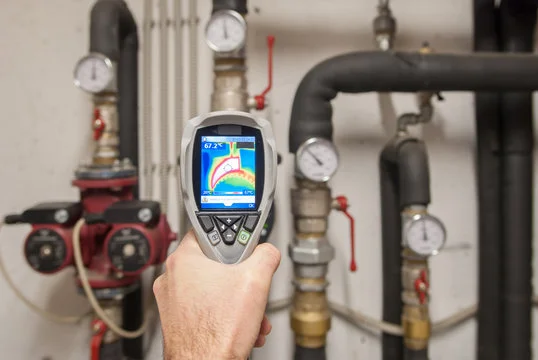
The leaks that do the most damage are rarely the dramatic ones. A pinhole in a pipe wall or a joint that’s slowly weeping can go unnoticed for months while it works away at the framing around it — mold gets a foothold, wood starts to rot, and the structural cost climbs well past what the actual repair would have run. Watch for a musty smell that won’t place itself, a stain spreading across a wall or ceiling, paint bubbling or drywall softening, or a water bill that’s crept up without explanation. Any of those is worth investigating. We use leak detection equipment to find exactly where the water’s coming from before we ever cut into anything, then make the smallest opening we can to reach it, fix it, and confirm the repair holds before closing things back up.
Pipe Corrosion and Deterioration Repair
Older galvanized steel rusts from the inside out. As that rust builds, it strangles the flow, drags your pressure down, and eventually opens pinhole leaks as the metal thins. Copper isn’t immune either — it can pinhole in spots with aggressive water chemistry or a lot of chlorine in the supply. When we find corrosion-driven leaks, we gauge how far the deterioration has spread to figure out whether a section repair or a broader repipe is the better value.
Frozen Pipe Thawing and Repair
Cold snaps put exposed pipe at risk — attics, crawl spaces, an exterior wall, an unheated garage — anywhere water sits without much protection from the temperature. Once it freezes, the ice expands and can split the pipe wall, though you often don’t know it until things thaw and water starts moving again through a crack that wasn’t there before. If you turn on a tap on a cold morning and get nothing, shut off your main valve before it has a chance to thaw and flood the house, then give us a call. We bring proper thawing equipment to get things moving again safely, and if the pipe already cracked, we’ll cut out and replace whatever failed.
Leak Detection in [CITY]
Finding a leak is often the hard part — fixing it is the easy half. Water travels, so a ceiling stain doesn’t mean the leak sits right above it. It runs along framing and pipe before it ever drips down, sometimes surfacing several feet from where it actually started. [BRAND NAME] uses professional detection equipment to locate leaks precisely before we open anything, keeping needless damage to your home to a minimum.
Slab Leak Detection and Repair
A slab leak means a supply or drain line running under your foundation has failed — usually from age, ground movement, or just years of the pipe expanding and contracting with temperature. The clues tend to be subtle: a patch of flooring that’s warm for no reason, water running somewhere in the house when every fixture is off, a water bill that doesn’t match your usage, or a hairline crack showing up in the slab itself. Since you can’t see the pipe to know exactly where it’s failing, we use acoustic equipment that listens through the concrete for the sound of water escaping — that pinpoints the spot without guesswork. From there you’ve got two paths: a targeted cut straight down to the pipe, or rerouting that section of line up through the attic or walls to bypass the buried run altogether. Rerouting is usually the less invasive option, and often the faster one too.
Wall and Ceiling Leak Detection
A ceiling stain or a damp wall cavity can come from any number of places — a supply line, a drain line, a fixture connection, even a roof penetration. We trace the water path methodically to find the real origin instead of opening walls at random. Once it’s located, we make a precise opening, repair the source, verify the fix under pressure, and let you know what finish work it’ll take to close the surface back up.
Preventative Pipe Maintenance in [CITY]
Annual Plumbing Inspection
A once-a-year look at the accessible plumbing — under sinks, at the water heater connections, at hose bibs, along any exposed runs — catches early corrosion, small drips at fittings, and failing supply lines before they turn into full failures. A slow drip found during an inspection costs a sliver of what a hidden leak running unnoticed for months will cost you in water damage. We offer scheduled annual inspections for homeowners who’d rather stay ahead of it.
Water Pressure Checks and Pressure Reducing Valve Installation
Pipes and fixtures fail sooner than they should when the water pressure feeding them runs too high, and depending on where you are, what’s coming off the municipal main can be more than residential plumbing was ever designed to handle continuously. A pressure reducing valve installed where the main line enters your home brings that down into a safer range — typically in the neighborhood of 50 to 70 PSI — which takes a lot of the ongoing strain off everything downstream. We’ll check what your current pressure is running and install or adjust a PRV if your system needs one.
Pipe Insulation
Exposed pipe in attics, crawl spaces, exterior walls, and unheated areas is at the mercy of temperature extremes. Insulating it guards against freezing in the cold and cuts heat loss on the hot water lines, which helps efficiency. We figure out which pipes in your home need it and wrap them with the right pipe wrap or foam insulation.
Commercial Pipe Repair and Repiping in [CITY]
Commercial buildings run bigger pipe systems under heavier demand, and they can’t absorb plumbing downtime the way a house can. A burst pipe or water line failure in a restaurant, office, or retail space can shut the doors and cost real money. [BRAND NAME] handles commercial pipe repair, water line service, and large-scale repiping for businesses throughout [CITY] and [COUNTY NAME] County.
We take on repiping for apartment complexes, hotels, office buildings, and multi-tenant properties, mapping the work to keep disruption to tenants and operations down — running the sections in an order that keeps water service to the property going as much as possible from start to finish.
Why [CITY] Homeowners Choose [BRAND NAME] for Pipe Repair
- Skilled pipe work: every joint fitted the right way for its material — sweated, crimped, or compression-fit — and pressure-tested before we ever close up a wall.
- Local plumbers: every call answered by our own crew, not a national dispatch line.
- Root-cause diagnosis: we figure out why the pipe failed so the same problem doesn’t circle back.
- Straight recommendations: if a section repair will hold, that’s what we do; if the wider system needs attention, we tell you plainly why.
- Low disruption: we open only what has to be opened and put surfaces back before we leave.
Pipe Problem in [CITY]? Call [BRAND NAME].
From a burst pipe to a whole-house repipe, [BRAND NAME] takes on every pipe repair and water line job in [CITY] and [COUNTY NAME] County with the skill and care your home deserves. Call now — every call is answered by a local plumber.